Thinking about a time you have been a part of an audience is interesting when you focus on context. It’s easy to say that we are constantly being part of an audience, whether it be within something as obvious as a movie theatre or something more obscure like seeing an advertisement for some cute top from BooHoo while you mindlessly scroll through Facebook.
But when asked about being a part of an audience I think back to the time I went to the Art Gallery of NSW in 2015 with my Year 12 Art Class. I was most excited to view a piece by Ai Weiwei as we were completing a case study on him at the time and has over the years become one of my favourite artists. To give a brief description of the work, it’s… well… a vase with the Coca-Cola Logo painted across the side of it.
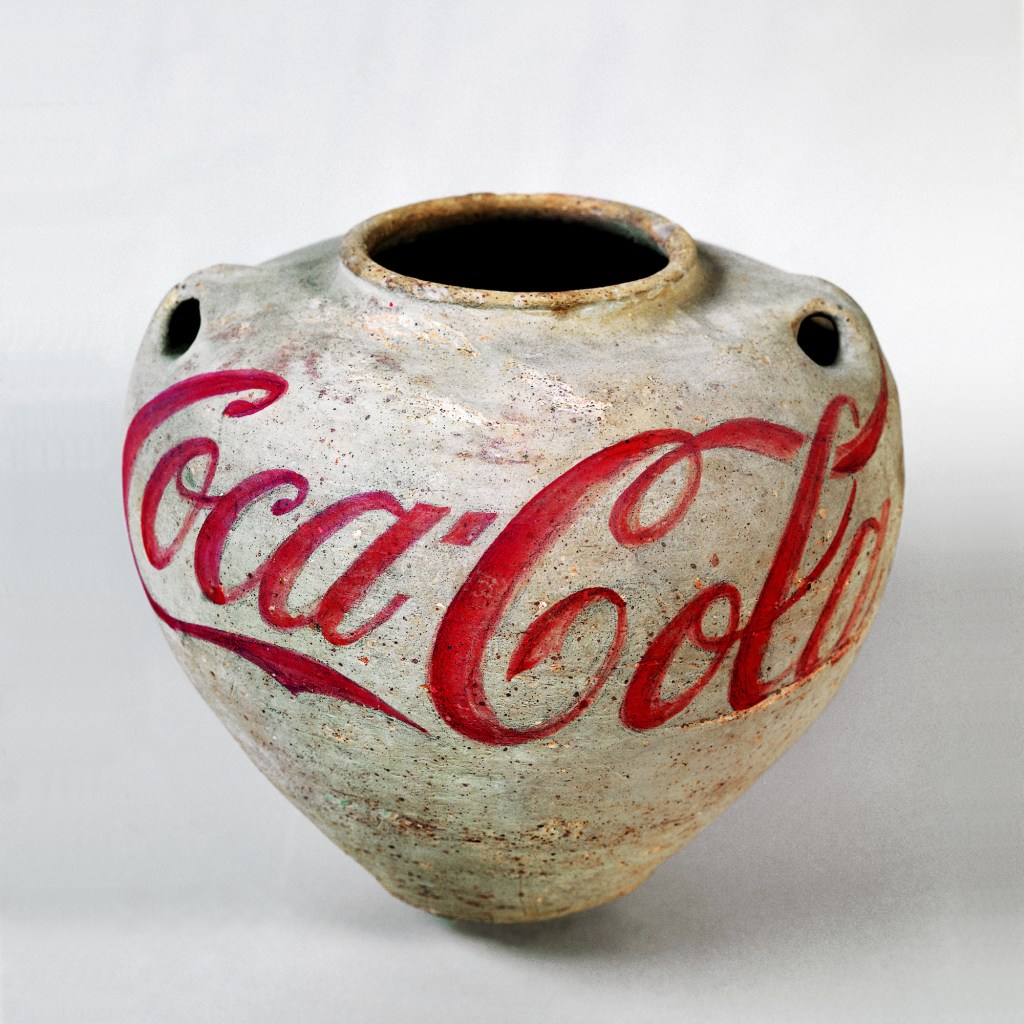
Han Dynasty Urn with Coca-Cola Logo (Weiwei, 1993) is, like the majority of Ai Weiwei’s works, a major ‘f*ck you’. Or, more appropriately described, ‘…the emblem of American capitalism juxtaposed with an ancient Chinese craft. It’s as simple as it is subversive… it delivers a blow to the seemingly unshakeable artefacts of history, rethinking their purpose and place in the modern world.’ (Benson, 2019)
I suppose you can guess the positives of this experience, being able to see the product of my favourite artists mind; to see something I’ve only seen in terrible textbook photocopies. However, what draws my memory back to this experience most is the lacklustre environment I was subjected to.
The one thing I hate most about the viewing experience in an art gallery is how quiet it is. The silence is deafening; It almost consumes the work more than music would if it were allowed. Not to mention the sterile rooms they present the art in, white walls with whiter detailing. The opposite, I feel, of what art is.
In ways, I feel this platform of presenting artworks is heavily outdated. I suppose art used to be for the rich, the people that could afford to consume it; meaning viewing art has this weird underlying snootiness to it that almost makes you feel uncomfortable to be in its proximity. The art is put in contrast with this attempt of perfection which just doesn’t seem to match anymore, especially when contrasted with contemporary pieces such as Ai Weiwei’s.
This seems to oppose the digital viewing spaces that we are now so lucky to have. Not only can we see pieces from across the world, we are able to view artists that may never be deemed worth putting into a gallery. Any artist with any capability can post their works for an audience to see, as well as allowing the audience to provide feedback which can’t be obtained as easily with gallery viewings.
You have the potential to mark the popularity of the exhibition on the amount of visitors/ticket sales, but that doesn’t represent the visitor’s feelings towards it. Just because they viewed it doesn’t mean they liked it. This relates back to the ideas explored in week two’s lecture where we discussed the differences in data being collected through television audiences. Instead of just quantitative data about what kind of content people are viewing, we can receive qualitative data which depicts the thoughts and feelings behind the viewing.
“‘Qualitative’ denotes interpretative and exploratory activities, rather than factually descriptive ones. In qualitative research, we are not usually involved in precisely defined terms or in accurate measures of human behaviour or attitudes.” (Mytton, Diem & Dam 2015, p164) Considering the question of what art even is is still a common thought amongst many scholars, I feel the collection of data that also doesn’t necessarily have a true meaning or definite value is the kind of information worth gathering. Art is incredibly subjective and quantitative data can’t possibly reflect this appropriately.
I much prefer the ease of scrolling through Instagram or Tumblr to view my days’ worth of art rather than walking into a stale art gallery that doesn’t offer anything unique. The benefit of the gallery is to see the work before you, but the discomfort and lack of accessibility makes it not worth the struggle for me personally.
Not to mention the world’s also in lock down at this current point in time so even if I were to decide that I’d want to venture out, I no longer can. However, in the privacy & protection of my own home, I can still consume and provide thoughts and feedback on the artwork that I desire.
But with this being more of an opinion piece, I’d love to hear your thoughts on Art Galleries and the Visual Arts culture online.
For now though, that’s all from me.
~Bree
Reference List:
Elephant 2019, ‘Coca-Cola meets china: Ai Weiwei’s subversive symbolism’, Elephant, weblog post, 21 April, viewed 11 March 2020, https://elephant.art/coca-cola-meets-china-ai-weiweis-subversive-symbolism/
Mytton, G, Diem, P & Dam P 2015, Media audience research: A guide for professionals, SAGE, Lodon.
 drawoncedrawtwice
Hey! Super interesting topic, I like it a lot as I’m also a huge fan of art. I think the debate between “high art” and popular culture is super interesting and I used to find myself feeling the obligation to defend popular culture and resent high art as a millennial but recently have become extremely appreciative of traditional art galleries. While the internet has opened us up to a vast array of artwork that we may never have been exposed to otherwise, I think history is also important and preserving such an iconic and ageless public sphere (Art galleries, a place of discussion about art and what politics and background influenced the art) is important. While I completely see your criticisms and understand the perspectives on them being eerily quiet and appealingly lonely, however I think there’s beauty in the silence and emptiness. I think it forces you to sit in your thoughts alone and analyse what you can take from an artwork. To let your mind wander and create your own meanings from a piece. And sometimes music can assist with that, but some modern art galleries provide music depending on the exhibition and how the artist intended for their work to be portrayed. Mona (the museum of old and new art) in Tasmania is insanely great for this. I think there’s a need and should be an appreciation for both online art spaces and physical spaces. Some find comfort in the traditional
LikeLike