https://youtu.be/hTV5h2DhuP4Within my research, I’ve been investigating the impacts that nostalgia and participatory media culture have had on the narrative of Old School Runescape to justify why the extension of a previous, ‘out-dated’ edition of the game harbours more popularity than its modernised counterpart, Runescape 3.
Nostalgia is what’s most important to the community, becoming my first epiphany when starting my research and aiding in my development of my analytical framework. Nostalgia stems from the way which we interpret our surroundings as we construct our identities, developing our personal understanding of culture. It’s currently interpreted more as an emotion that typically sparks from a comforting, pleasant memory we long to recover/recreate. Unfortunately, the feeling of nostalgia is typically very difficult to fulfil as it relies on the notion that this memory can be reproduced despite the changes in circumstance, culture, and sense of self. This is clear within the instance of Old School Runescape as it is impossible to regain the experiences accomplished within previous playthroughs as time has altered the experience through added environmental aspects. 2007 was a very different time to current day so the whimsical outlook on Old School Runescape is unachievable to the same extent.
This leads to my second epiphany when conducting my research, which encompasses the power Jagex has provided the community to impact the game. With Old School Runescape being a game dedicated to the 2007 edition, it is still continuously updated on the terms of popular vote. That is, the community are the ones to decide what expansions will be added to the main narrative of Gielinor. Participatory media culture, alternatively to consumer culture, refers to the audience of a given media niche to be active and providing contribution as affiliation, expression, collaborative problem-solving and circulation. By perceiving the true potentials of the state of media production and distribution within the digital age offers a whole new decentralisation to knowledge on given topics. This is emulated within the OSRS community through their attempt to preserve as much of the collective memory to today’s standards but the issue with this has presented itself within my final epiphany, the community is still unhappy.
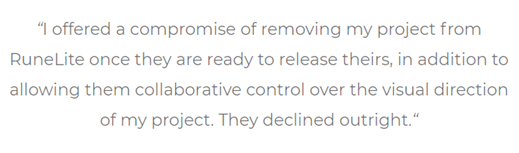
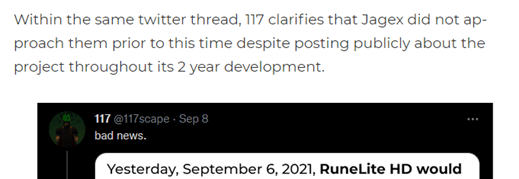
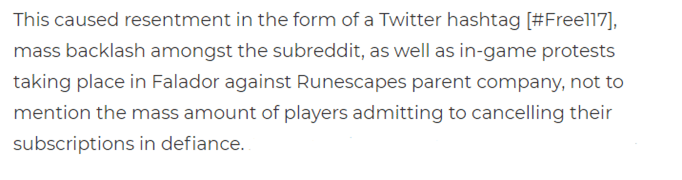
If the community can impact what elements of the game get changed or updated, why are they still unsatisfied? Despite Old School Runescape being the more popular iteration of the Runescape franchise, I’ve found through my involvement that a huge portion are unsatisfied with the implementations and decisions being made by Jagex. Within my first blog post posted this week, I did research into Jagex halting the release of a highly anticipated HD graphic mod that had been in the works for over 2 years by RuneLite, a third-party client for OSRS.
Despite the freedom the community has to input their opinion on OSRS, they’re still guilty of having not so favourable outlooks on the developers. Is the community aiding in their quest to recover the same nostalgic emotions or rather crafting a whole new narrative that has enticed a whole new subculture that has fallen for the current environment, maintaining its popularity overtime? The cycle of this analytical framework powers my research to understand the significance of these altercations in the grand scheme of production and distribution for Old School Runescape.
 drawoncedrawtwice
One thought on “Is The OSRS Community Ungrateful?”