With the abrupt discovery of COVID-19 soon came the collapse of normalcy within our day-to-day living, including the way in which students consume their education. While online learning is nothing new in the grand scheme of learning platforms, typically being used previously blended with on-campus teaching, it has forced most students across the globe into unmarked territory. However, is it possible for this abrupt transition to be beneficial for certain curriculums within a higher education setting or are the students of the COVID-19 era destined to fall behind?
It is found within a wide range of studies during the past year that many disciplines within a university or college context are struggling to meet the requirements necessary to mimic an on-campus education. This is mainly due to the limitations of online learning in terms of practical experience, noted by Mohamed (2020) when researching the academic performance of veterinary students across the globe.
‘Online education helps to keep the students up and running with an opportunity for self-study. However, the main challenge online education faces in veterinary medical science is how to give practical lessons. Since most of the subjects are practical; therefore, it is not easy to learn it online.’ (Mohamed, 2020)
This sentiment is also echoed within a study on medical and dental students within a university in Pakistan, documenting the ‘inefficiency to teach psychomotor skills’ (Mukhtar et al. 2020). Considering the requirements necessary to partake in their select career paths, online learning alone is seen to potentially have a negative effect on these students unless a blend of on-campus learning were to be introduced.
However, it begs the question of whether Communication and Media students are feeling the same affects, or rather the pandemic has allowed for a greater focus on their chosen subject at hand. Does this mean that these unprecedented times have led to a greater success for students under the Communications umbrella?
Once you reflect upon the skill sets required to be successful within a Communications and Media career, you begin to recognize the potential benefits of online learning in comparison with on-campus teaching. Below is the list of careers noted on the UOW website under Communications and Media for those unfamiliar with the discipline.
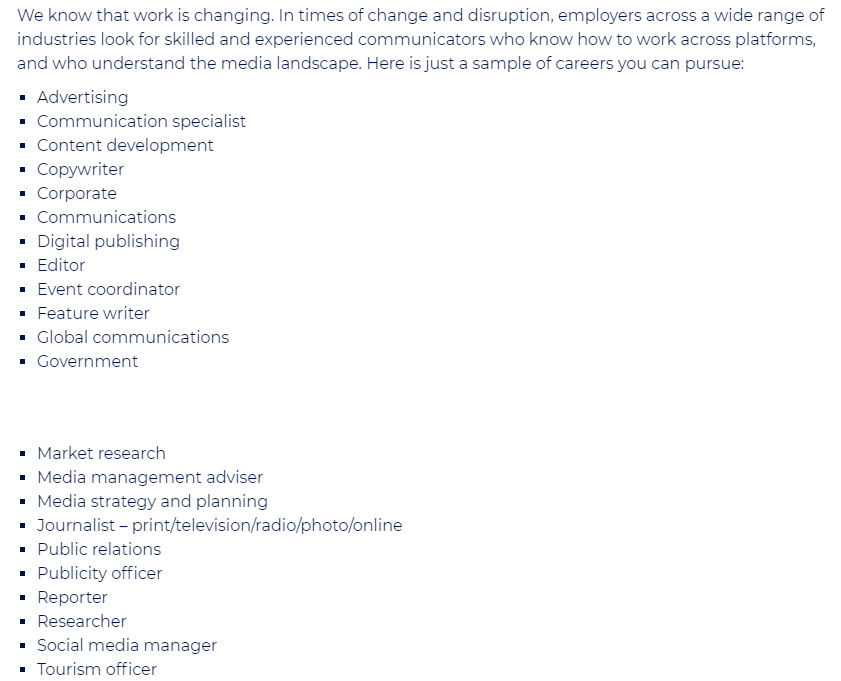
Self-directed learning is one of the skills arguably necessary for graduates across each of these career options; It is particularly important for Communications and Media students as the career environment rapidly changes and is sculpted by technological advancements and public interest. Beyond schooling, graduates will be required to continue to develop their personal skill set to keep up with industry standards. Some studies have found that self-directed learning skills are thoroughly developed through online learning as students don’t have the same kind of direct support from the university, leading to self-drive.
‘ODL students are proactive and have positive tendency to manage all learning activities and do perform better in the exams as well. Likewise, low mean of conventional university students indicated that they mostly rely on teachers’ instructions and peers activities to accomplish their academic tasks.’ (Khalid et al. 2020)
This is not to mention the new level of exposure to technological environments and challenges that have the potential to be beneficial. Post COVID-19 Pandemic, we are to find a completely different working environment, one more heavily reliant on technology to communicate and produce projects. While it was previously common practice to travel and to work in person amongst groups to complete required work, this will become a thing of the past thanks to the boom in conferencing platforms such as Zoom.
Thankfully, working within an online environment allows for the development of these skills as we begin communicating digitally for class, which differs greatly to the on-campus environment. Hoon et al. (2018) explains that ‘the passiveness of the traditional educational process (e.g., lecture presentations) does not serve to capitalize on the knowledge of the adult learner’ where as online learning ‘offers the adult learner the ability to work as collaborative partners in the learning process due to the nature of the online discussions and sharing of assignments’.
Is this to argue that Communications students graduating from the COVID-19 era will harbor more refined digital and learning skills than previous graduates? Within the coming weeks through survey work and talking to peers, I’m looking to address academic performance along with assessing the students use of technology and online learning to gauge whether they are engaging with the space in a constructive way. Within my research, I hope to find how the students of BCM212 are using online learning and whether these beneficial skills mentioned are being retained to reflect upon my assumption that Communications and Media students are benefiting from working within an online environment due to COVID-19.
Reference List
Hoon, S, Wilkins, P & Perry, A 2018, ‘Adult learning and the advantages of the online learning experience’, Westcliff International Journal of Applied Research, Vol. 2, No. 3, viewed 20th March 2021, <https://wijar.westcliff.edu/wp-content/uploads/2020/10/Hoon-Wilkins-2018-22-DOI.pdf>
Khalid, M, Bashir, S & Amin, H 2020, ‘Relationship between self-directed learning (SDL) and academic achievement of university students: a case of online distance learning and traditional universities’, Bulletin of Education and Research, Vol. 42, Iss. 2, viewed 19th March 2021 <https://search-proquest-com.ezproxy.uow.edu.au/docview/2472157102?accountid=15112&pq-origsite=primo>
Mohamed, M 2020, ‘The impact of COVID-19 pandemic on the academic performance of veterinary medical students’, Frontier of Veterinary Science, Vol. 7, viewed 18th March 2021 <https://www.ncbi.nlm.nih.gov/pmc/articles/PMC7572855/>
Mukhtar, K, Javad, K, Arooj, M & Sethi, A 2020, ‘Advantages, limitations and recommendations for online learning during COVID-19 pandemic era’, Pakistan Journal of Medical Sciences Quarterly, Vol. 36, Iss. S4, viewed 18th March 2021, <https://search-proquest-com.ezproxy.uow.edu.au/docview/2413712377?accountid=15112&pq-origsite=primo>
 drawoncedrawtwice