I believe that citizen journalism can have positive and negative effects depending on the circumstance in which it is used and its consequences to the citizen themselves. I say this mainly about my good, old friend (not really, I wish) and activism artist Ai Weiwei, who I have referenced in a previous BCM110 blog post. Funnily enough, he does relate to this topic hence why I will be referencing him and his struggles with citizen journalism against the Chinese government.
Firstly, I will be providing a view into the Chinese media; the Press Freedom Index (2020) documents China at 177 out of 180, labelling the country as being in a ‘Very Serious Situation’, the lowest level on the scale and just looming three spots ahead of North Korea (180 out of 180);
‘China’s state and privately-owned media are now under the Communist Party’s close control… More than 100 journalists and bloggers are currently detained in conditions that pose a threat to their lives.’ (RSF Reporters Without Borders. 2020)
All commutative forms of media within China are closely supervised by the Chinese government, with strict regulations dictating what topics are too taboo to be discussed including pornography, the legitimacy of the communist party, government policies within Xinjiang and Tibet and, more recently, the Coronavirus Pandemic. It is said that this censorship of information enforced by the Chinese government relating to Covid-19 is what lead to the overwhelming spread of the virus early on. Many journalists have been jailed in life threatening conditions due to government censorship, this includes three journalists and three political commentators in connection to the pandemic with a total of sixteen foreign correspondents being ‘expelled’ since the beginning of 2020.
But how does this connect to Ai Weiwei? Well, with his creation of his installation ‘Remembering’ (2009), in which involved the installation of 9,000 school backpacks in a variety of colours to spell out ‘All I want is to let the world remember she had been living happily for seven years.’ across the Haus der Kunst in Munich, German, was an activist artwork at its finest that initially began through simple blog posting. An earthquake within Sichuan during 2008 saw close to 80,000 lives disappear; many of the dead were young students as the buildings crafted by the Chinese government to be used for schools were inadequately built to survive an earthquake.
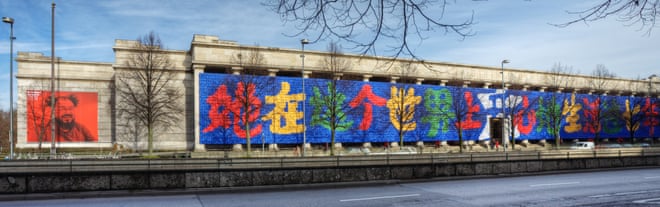
‘The Chinese government censored and controlled all of the information about the earthquake, so people didn’t know what the details of what really happened… I made hundreds of phone calls to the education department, the police and civil department, to ask questions about the student causalities, but of course nobody would talk to me.’ (Weiwei, 2018)
Weiwei set up a citizen investigation team of roughly 100 people, after having his blog shut down by the Chinese government after attempting to collect information on the deaths, to go from door to door to document the truth of the destruction as research for his piece, bring awareness to not only the 5,219 names of children lost to the school collapses they collected but to the severity of the censorship in his country to people across the globe;
‘I was put in jail and had all kinds of struggles with authority. Remembering was a high point. The kind of authoritarian state we have in China cannot survive if it answers questions – if the truth is revealed, they are finished. So they started to think of me as the most dangerous person in China.’ (Weiwei, 2018)
Thanks to his initial use of blogging and social media outlets, Ai Weiwei became one the most dangerous people in China; if that doesn’t show you the power of citizen journalism, I don’t know what else will.
Reference List
RSF Reporters Without Borders 2020, China: even tighter control, RFS Reporters Without Borders, viewed 21August 2020, <https://rsf.org/en/china>
Weiwei, A 2018, Ai Weiwei: the artwork that made me the most dangerous person in China, The Guardian, weblog post, 15 February, viewed 21 August 2020, < https://www.theguardian.com/artanddesign/2018/feb/15/ai-weiwei-remembering-sichuan-earthquake>
 drawoncedrawtwice